
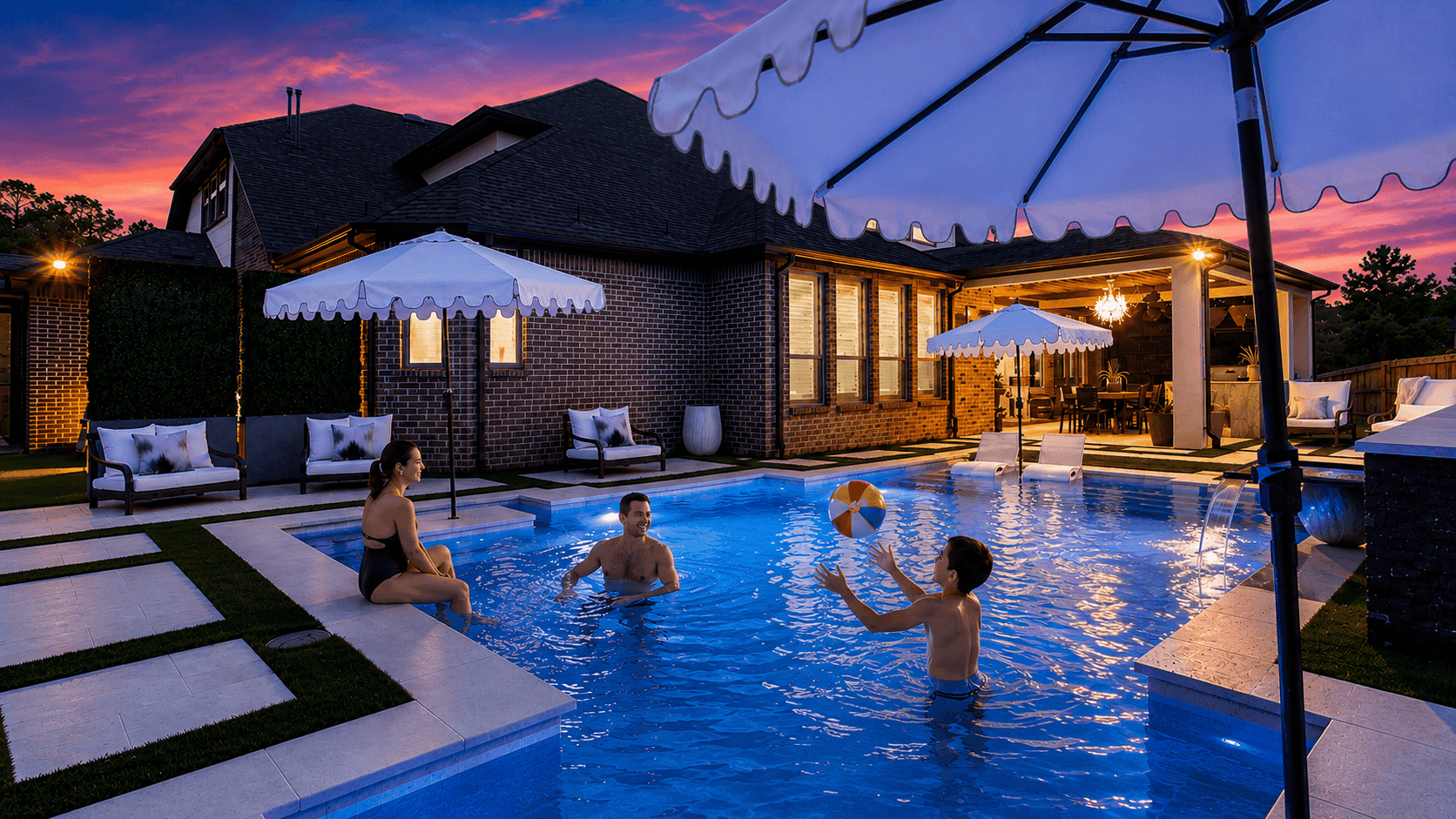
Fire Feature Installation in Pearland, TX
Fire features extend the backyard into the cooler months - Houston's mild winters make a fire pit or gas fireplace usable most evenings from October through March. Designed as part of the pool project, they anchor a second seating zone and give the pool a visual counterpoint after dark. In Pearland, that work is fire pit and fire feature installation for a specific yard in Brazoria / Harris County, not a city name pasted onto a stock plan. Pearland's rapid growth means we build on both mature lots and brand-new construction - the two need very different site preparation.
Fire features run from small stand-alone pits to full masonry fireplaces built into a pavilion wall. Gas is the more common fuel - cleaner start-up, less smoke, and a lower fire code footprint than wood - but wood-burning pits still have a place when a homeowner wants the smell and crackle. Placement matters: fire pits should sit at seating distance from the pool but not so close that overspray from swimmers hits the burner. Prevailing wind direction affects both smoke drift and comfort at the seating ring. Fire-and-water bowls - the ones with a bowl of fire sitting above a water scupper - get installed as part of the pool shell and share the gas run and electrical the pool build already needs. Any gas plumbing runs through the same permitting and inspection track as the pool's other utilities, which is another argument for handling the fire feature during the pool build rather than as a retrofit.
What fire features means on this project
Gas is the default because it starts cleanly and does not put smoke through a dinner. Wood is the right choice when someone specifically wants a fire, and the code path is different. We will say which one the yard can support.
Place the flame where people sit, out of the splash, and downwind of the table if the breeze has a habit. A bowl that combines fire and a water scupper is built with the pool shell so the gas line is inspected with the other utilities.
A fire feature added years later still needs a gas line and a shutoff someone can find. We will not hide that work behind a bush.
How outdoor kitchens and fire features get built with the pool
An outdoor kitchen or a fire feature is worth building with the pool when the trenches are already open. Gas, water, and electrical are cheapest before the deck is poured. Adding them two years later means cutting finished stone to bury a line you could have stubbed during construction.
A kitchen on a Houston deck is a weather project. Standard indoor cabinets fall apart in this humidity and this sun. The boxes need to be masonry, stainless, or another material actually rated to live outside. Counters need to handle UV and heat; granite, quartzite, and dense concrete do. The layout has to work as a kitchen — grill, a place to set a tray, storage, and usually a sink or a cooler — and it has to face the pool so people are not walking a plate across the yard.
Fire features earn their place from October through March, which in Houston is a long stretch of evenings when the pool is still in view and the air is finally cool enough to want a flame. Gas starts cleaner and smokes less than wood. The pit or bowl has to sit at seating distance from the water without catching overspray, and the prevailing breeze decides where the smoke goes. A fire-and-water bowl that is part of the pool shell shares the gas run and the inspection with the rest of the build.
Pergolas and pavilions change the electrical plan. Fans, lights, and heaters ride overhead, and that load should be in the same permit conversation as the pool equipment. We coordinate those trades so the kitchen is not waiting on a gas line that nobody scheduled.
Houston Cool Pools publishes new-pool project ranges at $65k–$90k, $90k–$115k, $115k–$150k, and $150k and up. Those are ranges of finished projects, not a bid for your yard.
What moves a new gunite pool from one range to the next is concrete: water-surface size, whether there is an attached spa, the deck material, the interior finish, and how hard it is to get equipment into the backyard.
If the kitchen or the fire feature is the only project — the pool is already there — we still need to see the deck, the equipment pad, and where gas can enter. Photos help. The office number is (281) 645-6631, at 21902 Highway 249, Houston, TX 77070.
Gas work is permitted with the rest of the utilities. A line that was “just added by a handyman” is not a starting point we will extend. We want a shutoff you can reach without moving a grill, and we want the line sized for the appliances you actually bought, not for a future outdoor fridge nobody selected. If the kitchen includes a sink, the drain has to go somewhere legal. Tying it into a pool backwash line is not that place.
Houston heat is the other design problem. A kitchen with no shade is a kitchen you will not stand at from June through September. The pergola or pavilion is not decoration on top of a finished grill. It changes footing locations, electrical load, and where rain falls onto the deck. Draw it with the grill. A fire feature under a low cover also needs clearance. We will not put a flame where the manufacturer’s clearance does not fit, even if the rendering looked tighter.
People comparing outdoor kitchen builders and fire pit contractors in Houston are usually comparing who owns the coordination. The mason, the gas fitter, the electrician, and the pool deck crew can each be competent and still leave you with a counter that does not meet the coping. One schedule is the product. Ask who calls the inspection and who is on site when the deck is poured over the conduit. If the answer is “the other guy,” keep asking.
Budget the outdoor work as its own line, not as a rounding error on the pool. A grill island with a real counter, a sink, and shade is a construction project. A fire bowl tied into the bond beam is a construction project. Both can share the pool’s crew and still deserve their own scope, their own gas load, and their own place on the calendar.
What changes the work in Pearland
Pearland (South Houston, along TX-288) is one of the places we build. The notes below are the site conditions that change fire pit and fire feature installation here. They are not a slogan with the city swapped in.
Pearland crosses Brazoria and Harris counties along 288. Newer sections have open lots and builder swales. Older streets have trees and fences that set the access. The same city name covers both, so the site visit is not optional.
Open lots tempt people into oversized water. Size it for how you swim and for what it costs to heat and to chemically maintain. A larger surface loses more heat and collects more debris. The drawing should show that tradeoff.