
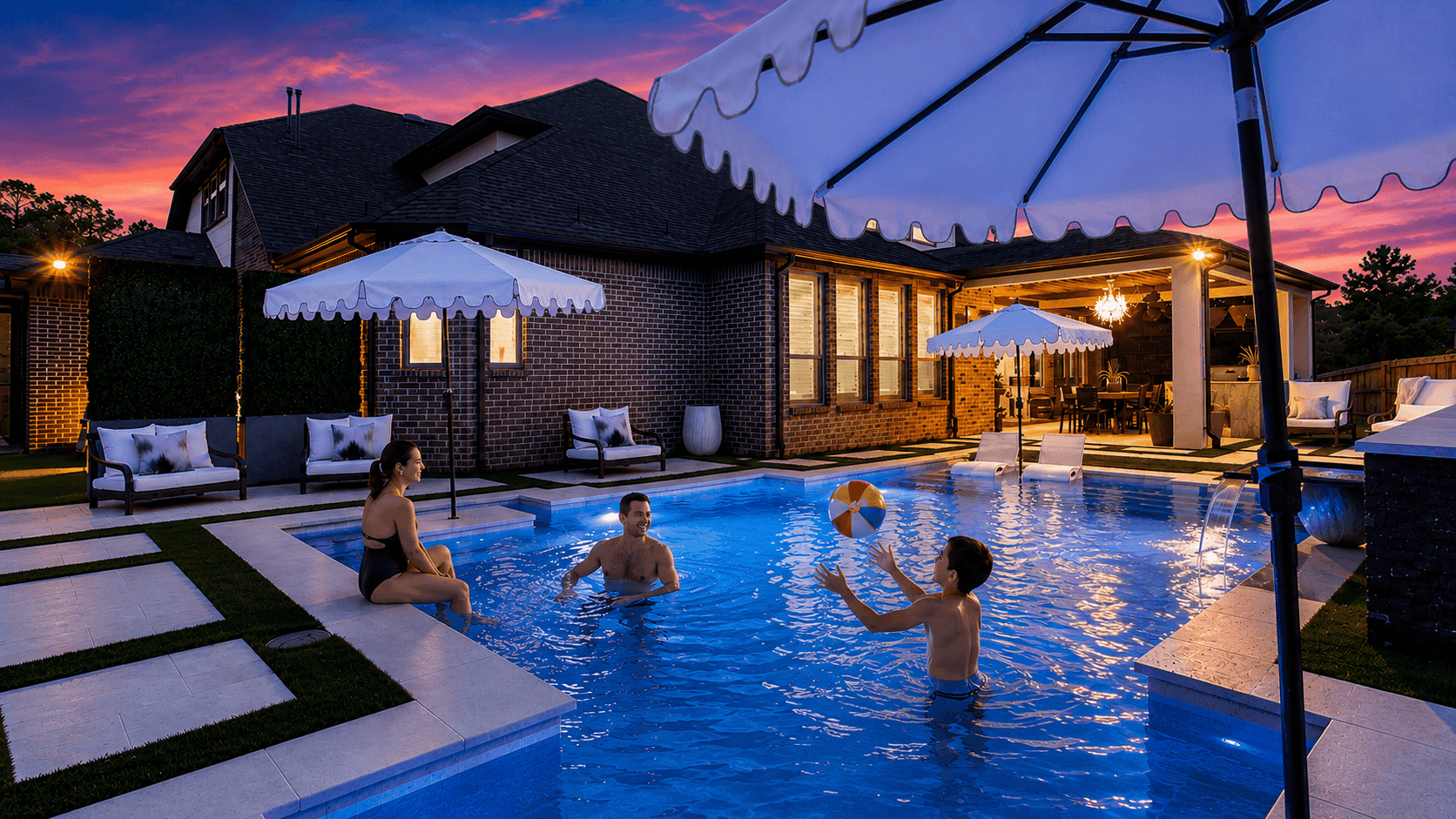
Geometric Pool Builder in Pearland, TX
Geometric pools - rectangles, squared-off L-shapes, and clean-line variants - read as architectural rather than natural. They pair well with modern and traditional home styles alike, and they tend to sit right against the deck rather than melting into landscaping. In Pearland, that work is geometric pool design for a specific yard in Brazoria / Harris County, not a city name pasted onto a stock plan. Pearland's rapid growth means we build on both mature lots and brand-new construction - the two need very different site preparation.
Geometric pools rely on precision. The layout has to be dead-square, the coping has to hold a straight line at the eye level of anyone walking past, and the tile has to align cleanly at inside and outside corners. Rectangular is the most common geometric shape but not the only one - squared-off L's, T's, and stepped rectangles all read as geometric when the corners are crisp. Attached spas at this style are almost always squared to match the pool, either raised above the deck as a bond-beam-forward feature or set flush with the pool coping. Deck materials tend toward larger-format pavers or poured concrete with clean control joints. Water features fit in as sheer descents from a raised wall, spillover scuppers, or a shallow reflecting-pool section rather than the boulder waterfalls that suit freeform designs. The gunite construction sequence is the same as any custom pool - precision on the front end just carries through to the finish.
What geometric pool builder means on this project
Geometric pools are rectangles, L-shapes, and other squared outlines. They read as part of the house. The layout has to be square, the coping has to stay straight at eye level, and the tile has to meet cleanly at the corners. Sloppy geometry looks worse than a freeform curve, because the eye knows where the line was supposed to be.
Spas on these pools are usually squared to match. Water features tend to be sheer descents and slots, not boulder piles. Deck joints are drawn, not improvised, so the grid of the paving lines up with the coping.
Modern and traditional houses both take this shape. The difference is the material, not the outline. A rectangle in limestone coping and a rectangle in dark tile are not the same pool.
How a custom gunite pool is actually built
Hiring a pool builder in Houston is a construction decision, not a catalog order. The companies that show up for “pool contractor,” “swimming pool construction,” and “custom pool builder” are not all selling the same thing. Some install a fiberglass shell that arrives on a truck. Some sell a package shape. Houston Cool Pools designs and builds gunite: a steel cage, then a concrete shell sprayed on your lot, then tile, coping, deck, and an interior finish. The shape is whatever the drawing says, because there is no mold.
Fiberglass is a legitimate product. It is also a different product. The shell is manufactured off-site, so the widths, depths, and steps are the ones the mold allows. Gunite is the method behind the custom pools people are usually picturing when they search for a pool builder in Houston: a beach entry on one side, a spa on the other, a sun shelf where the shade actually falls, a raised bond beam if the house sits above the yard. If a salesperson cannot explain which method they build, you do not have a proposal yet.
The design visit is where most of the expensive mistakes are avoided. We look at where water already sits after a storm, where the afternoon sun lands, what you see from the kitchen and the primary bedroom, and whether a fence, a tree, or an easement cuts the usable yard. Equipment has to reach the hole. On a wide suburban lot that is simple. On a fenced inner-loop lot it can decide the shape before the finish does. Bring the survey if you have one, and the HOA architectural rules if the neighborhood has them. We would rather read the rule before we draw than redraw after a committee.
A gunite build follows a sequence, and skipping a step is how pools fail later. Layout and excavation come first. The hole is cut larger than the finished water so the steel and the shell have room. Rebar is tied to the engineered spacing. Plumbing is stubbed and pressure-tested while it can still be seen. Gunite is then sprayed so the steel sits inside the shell, not against one face of it. The shell cures before tile, coping, and deck go on. The interior finish — plaster, quartz aggregate, or pebble — is a wear surface over that structure, not the structure itself. Startup is a separate appointment: the equipment is run, the chemistry is set, and someone walks you through the pump, filter, heater, and light. Video is fine. There is a lot of it.
Greater Houston is not a gentle site. A lot of the metro sits on clay that shrinks when it dries and swells when it rains. The shell is built for that. The deck is not glued rigidly to the coping; a joint there is what keeps the first dry summer from telegraphing a crack across the walking surface. Drainage has to leave the bond beam and the equipment pad. A pool that holds storm water against the shell is a maintenance problem you will notice every June.
Permits follow the address, not the marketing map. A house inside the City of Houston is not reviewed by the same desk as a house in unincorporated Harris County, and Montgomery, Fort Bend, Waller, Brazoria, Galveston, and Chambers counties each have their own path. We confirm the jurisdiction before drawings are submitted and we schedule the inspections that jurisdiction requires. You should not be the person standing in the yard wondering which inspector is coming.
Schedule for a custom gunite pool is generally 8 to 16 weeks from the day we break ground to the first swim. Weather, inspection timing, and the number of features move that window. An attached spa, a vanishing edge, or a difficult access path adds time. A straight rectangle on an open lot does not. We give you the sequence before we dig, and the backyard should not go quiet without you knowing which trade is next.
Houston Cool Pools publishes new-pool project ranges at $65k–$90k, $90k–$115k, $115k–$150k, and $150k and up. Those are ranges of finished projects, not a bid for your yard.
What moves a new gunite pool from one range to the next is concrete: water-surface size, whether there is an attached spa, the deck material, the interior finish, and how hard it is to get equipment into the backyard.
A remodel, a resurface, a deck replacement, or an equipment change is priced from the existing pool, not from those new-build ranges. If the shell has to be cut and new gunite tied in, the job starts to look like construction again and the schedule changes with it.
Financing is available for qualified homeowners. A monthly payment is not a reason to skip the design conversation. The number only means something after the drawing shows the size, the depth, and the deck. Our office is at 21902 Highway 249, Houston, TX 77070. The phone on this website is (281) 645-6631.
Published new-pool ranges live on $65k–$90k, $90k–$115k, $115k–$150k, and $150k and up. The build sequence is written out on the construction sequence pages.
What changes the work in Pearland
Pearland (South Houston, along TX-288) is one of the places we build. The notes below are the site conditions that change geometric pool design here. They are not a slogan with the city swapped in.
Pearland crosses Brazoria and Harris counties along 288. Newer sections have open lots and builder swales. Older streets have trees and fences that set the access. The same city name covers both, so the site visit is not optional.
Open lots tempt people into oversized water. Size it for how you swim and for what it costs to heat and to chemically maintain. A larger surface loses more heat and collects more debris. The drawing should show that tradeoff.